

What Is a Crate Washer?
In industries that require frequent use of crates, how to clean them becomes a challenge. Manual cleaning often fails to meet hygiene standards, is costly, inconsistent, and slows down production.
A crate washer is a machine that cleans and sanitizes crates, plastic boxes, and trays automatically. It ensures hyginene and saves time in high-volume operations.
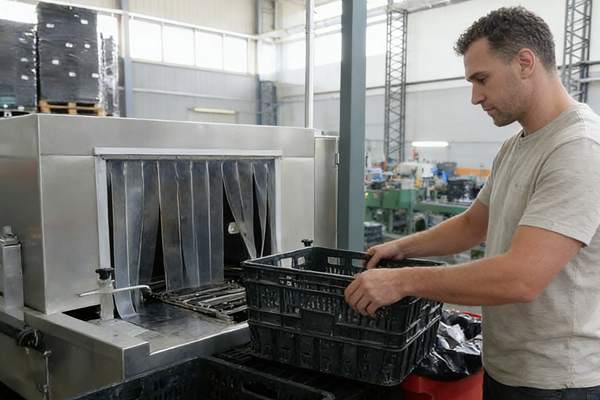
In this article, You will learn things you need to know about the crate washer. Explore how it works, where it’s used, and what should you consider when buying a crate washer.
How Does a Crate Washer Work?
A crate washer works much like an automated car wash:
- Crates are placed onto the conveyor.
- The crates move through a washing tunnel.
- High-pressure water sprays clean the crates from all four sides.
- Each surface of the crate is thoroughly cleaned.
- Some machines include a drying stage.
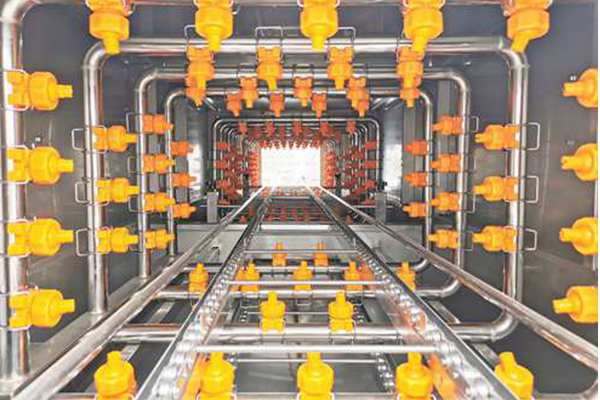
The Cleaning Stages
A crate washing machine typically includes three main cleaning zones—a pre-wash zone, a main wash zone, and a rinsing zone—with an optional drying section.
-
Pre-Wash Zone: Spray nozzles clean the crates with lower water temperature, removing large debris and loose particles.
-
Main Wash Zone: Spray nozzles clean the crates with very hot water, removing dirt and residues in combination with the appropriate detergent.
-
Rinse Zone: Crates are rinsed with fresh water to remove residual detergent.
-
Blow-Off Drying(optional): Fans blow air through the crates to remove most of the water, allowing them to be used immediately.
Machine Structure & Main Components
Crate washers come in different shapes and sizes, but their basic structure is similar. Here, I'll use the Mecceed MEC7000 model as an example.
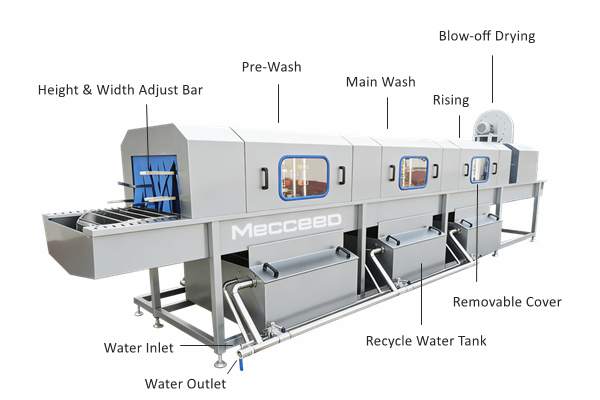
- Stainless steel frame (SUS304/316)
- Transport System
- Water Pumps
- Multi-angle spray nozzles
- Water filtration and circulation systems
- Heating system
- Electric Cabinet
- Blow-off Drying Unit
- Removable Cover
Crate Washer Specification
While models vary by manufacturer,general specifications remain similar. Below are the specifications for Mecceed crate washers for your reference.
| Model | Washing Capacity | Washing Stage | Drying Stage | Voltage | Machine Dimension |
|---|---|---|---|---|---|
| MEC4000 | 100-200 pcs/h | 2 | / | 380V/3PH/50HZ or Customized | 4000x1700x1600mm |
| MEC5000 | 200-300 pcs/h | 3 | / | 380V/3PH/50HZ or Customized | 5000x1700x1600mm |
| MEC6000 | 400-600 pcs/h | 3 | / | 380V/3PH/50HZ or Customized | 5800x1700x1600mm |
| MEC7000 | 400-600 pcs/h | 3 | 1 | 380V/3PH/50HZ or Customized | 7000x1800x1900mm |
| MEC8000 | 600-800 pcs/h | 4 | / | 380V/3PH/50HZ or Customized | 8000x1700x1600mm |
| MEC10000 | 1000-1200 pcs/h | 5 | / | 380V/3PH/50HZ or Customized | 10000x1700x1600mm |
Note: Capacity based on 600x400x300mm crate dimensions.
Each machine will be customized based on your specific crate dimensions, washing capacity, and cleaning requirements. For more information, please contact [email protected].
Which Industries Use Crate Washers?
- Food Processing
- Meat & poultry plants
- Dairy production
- Seafood processing
- Fruits & Vegetables Processing
- Bakeries & Confectionery
- Logistics & Distribution Centers
- Retail & Supermarket Distribution
- Agriculture & Farming
- Pharmaceuticals & Medical
- Manufacturing & Automotive
Cleaning Capacity
The cleaning capacity of an industrial crate washer typically ranges from about 100 up to several thousand crates per hour, depending on machine size, configuration, soil level, and conveyor speed.Typical capacity ranges are:
- Small / compact units: About 100–300 crates per hour, suitable for smaller plants or low to medium volumes.
- Medium units: Roughly 300–1000 crates per hour; many standard crate washers sit in the 400–800 range.
- Large units: From 1,000 up to 2,000+ crates per hour.
It’s important to note that the output of a crate washer is not fixed. It depends on how dirty the crates are. Mecceed will design a crate washer based on the dirtiness of your crates and the required cleaning output.
Benefits of Using a Crate Washer
-
Consistency and Hygiene - More reliable clean than manual washing, reducing contamination risks.
-
Save time - Clean each crate in seconds instead of minutes.
-
Reduce costs - One operator can manage a machine that replaces several workers doing manual washing, greatly reducing labor costs.
-
Save water, energy and chemical - With a water recycling system, it saves 40-80% of water compared to manual washing.
-
Easy adjustable click nozzles - Ensures thorough cleaning coverage on all sides of crates.
-
Improves employee safety - Minimizes exposure to hot water as well as chemicals.
-
Environmental Friendly - Uses circulation system to lower water and energy consumption and chemical use.
How to Choose the Right Crate Washer?
If you’re buying a crate washer for the first time, you might be confused. These machines often look similar, but the price differences are huge. So, what should you focus on besides price? Here are the key factors you must consider.
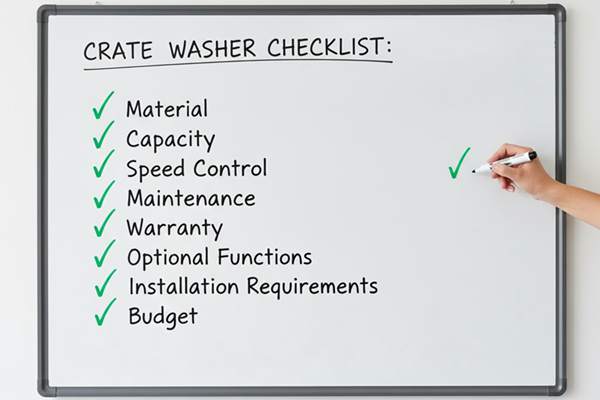
1. Material
The machine must be made from SUS304 stainless steel or higher. This ensures it is rust-resistant, durable, and easy to sanitize. Avoid 201 stainless steel, which is much cheaper but prone to rust over time.
2. Control System
The control panel should be easy to operate, whether it uses push-button switches or a PLC system. An emergency stop button is essential for safety. Additionally, high-quality electrical components from brands like Schneider or Siemens can reduce failure risk and make replacement parts easier to source locally.
3. Cleaning Capacity
Know how many crates you need to wash per hour and choose a machine that fits your need.
4. Adjustability
If you have crates of different sizes, the washer should be configured with adjustable guide bars for both width and height.
5. Conveyor Speed Adjustment
There are two ways to adjust the conveyor speed:
● Manual Adjustment : The conveyor speed is controlled via a knob on the motor reducer. This method less precise and less convenient to operate.
● Frequency-Converter (VFD) Adjustment: The speed is controlled by a frequency converter in the control cabinet.This makes adjustments easier and more accurate.
At Mecceed, all crate washers are equipped with frequency-controlled speed adjustment, using VFD such as Schneider. This greatly improves the machine’s ease of operation, precision, and long-term stability.
6. Heating Method
Crate washers are typically equipped with hot-water washing, so you need to choose the heating method that suits your operation.
The most common options are:
● Electric heating or steam heating
● Steam heating
● Gas heating (less common)
If you already have a boiler, you can choose steam heating. If not, you will need to select electric heating or purchase a steam generator to support steam-based heating.
7. Power and Voltage
Check the machine’s power requirements and voltage before purchasing to ensure compatibility with your facility’s electrical setup.
8. Optional Features
Consider which additional functions are needed for your operation. Optional features may include drying units, automatic crate loading and unloading, crate flipping, and integrated conveyors.
9. Maintenance, Cleaning, and Ease of Use
A simple structure with removable covers makes cleaning and maintenance easier.
10. Installation, Warranty, and Service
Confirm whether installation and commissioning are included. Ensure the supplier provides a reliable warranty, free replacement parts during the warranty period, and lifetime technical support.
11. Customization and Certification
Check whether the machine can be customized to match your crate sizes, production capacity,workshop layout or other requirement.
If importing, verify any required certifications, such as CE for Europe.
Conclusion
A crate washer plays a crucial role in modern food processing and distribution filed. Investing in a crate washer is a strategic decision that safeguards your products, enhances workflow, and supports long-term business growth.
We have supplied customized crate washers to clients in over 40 countries. If you’d like more information or have questions about crate washing solutions, feel free to contact us at [email protected]. Our technical team will be happy to assist..