

In many food and industrial plants, drying is only about appearance. It affects hygiene, safety, and downstream processing. This is why air knife drying systems are now common on modern production lines.
What Is an Air Knife Drying System?
An air knife drying system is a drying device that uses controlled, high-velocity air through a narrow slot to remove surface water from products after washing.
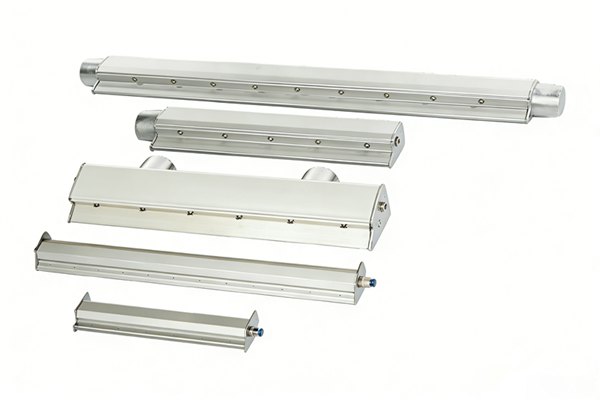
It is usually built as a long, narrow unit connected to a centrifugal blower. As products move past, the airflow forms an air curtain that removes surface water quickly and evenly. The system uses low pressure and high air volume, which suits high-speed production lines.
How Does an Air Knife Work?
An air knife works by converting air pressure into a high-velocity, laminar airflow that shears liquid off the surface and carries it away.
The working principle is based on fluid dynamics. Air enters the knife body and exits through a narrow slot. As the slot narrows, air speed increases. This fast air creates a force greater than surface tension. Water breaks away and moves off the product.
Several factors affect performance. Distance from the surface is critical. Too far reduces force. Too close causes splash-back. Angle also matters. A slight tilt helps guide water away instead of spreading it.
At Mecceed, we place air knife blowers after the wash and rinse stages so products go through the airflow right after washing. Once properly set up, the system runs reliably with minimal adjustment.
Applications of Air Knife Systems
In food machinery, air knives dry bottles, cans, trays, and fresh produce after washing. They are also used to remove dust or moisture before labeling, filling, or packaging.
| Industry / Area | Application |
|---|---|
| Beverage | Dry bottles or cans after washing; remove water before labeling to prevent glue failure |
| Food Processing | Dry trays, crates, or fresh produce after washing |
| Packaging | Remove dust or water from packaging materials before sealing or labeling |
| Bakery & Confectionery | Remove excess water or crumbs from trays and conveyors |
| Dairy | Dry bottles, cartons, or tubs after washing or rinsing |
| Frozen & Ready Meals | Remove surface water to prevent ice formation or sticking during packaging |
Beyond food machinery, air knives are also applied in industries such as pharmaceuticals, automotive, metal processing, and electronics.
What Are the Benefits of Using an Air Knife System?
Air knives improve efficiency and help meet sanitation standards. The key benefits include:
-
Fast and Consistent Drying - Create even airflow and remove water in seconds. No wet spots, no drying delays.
-
Improved Production Efficiency - Drying happens inline after washing. No waiting time, no extra handling.
-
Reduced Operating Costs - Manual drying is eliminated. Less labor, less rework.
-
Energy Efficient Operation - Use ambient air. No heaters, no high energy load.
-
Hygienic Drying Process - Drying is contact-free. Less moisture, lower contamination risk.
-
Consistent Product Quality - All surfaces dry evenly. No water marks, no quality variation.
-
Low Maintenance and Long Service Life - The system has few moving parts. Simple service, long operating life.
Air Knife Drying vs Traditional Drying Methods
Traditional drying methods include heated tunnels, sponge rollers, and cloth wiping. Each has limits. Heat may affect product properties. Rollers contact the product and collect dirt. Wipes depend on labor and are inconsistent.
| Method | Contact | Energy Use | Hygiene | Speed |
|---|---|---|---|---|
| Hot air tunnel | No | High | Medium | Medium |
| Roller drying | Yes | Low | Low | Medium |
| Cloth wiping | Yes | Low | Low | Low |
| Air knife | No | Medium | High | High |
Air knives avoid most of these issues. They are compact and modular. They can be added to existing lines with minor changes.
Can Air Knives Fully Dry the Product?
In most cases, it is not necessary to dry the product completely after washing in food processing. The main goal is to remove most surface water and prepare the product for the next step. Fully drying takes more time and costs more. Longer drying can sometimes affect the product.
The drying level depends on several factors, such as:
-
Product shape – flat surfaces dry faster than uneven or complex shapes.
-
Conveyor length – longer belts give more time for drying.
-
Water thickness – thicker water layers take longer to remove.
-
Air speed – higher air speed removes water faster.
-
Number of air knives – more knives increase drying coverage.
During manufacturing, we often test the machine with actual products. Based on testing, air knives typically remove 80-95% of water, which is sufficient for many processes. However, if the customer requires complete drying, the machine can be designed accordingly.
How Is an Air Knife System Maintained?
Maintenance tasks are minimal. The air knife body has no moving parts. Regular cleaning of nozzles, filters, and occasional blower inspection is usually enough.
Conclusion
Air knife drying systems remove liquid fast, cleanly, and without contact. With proper design, they improve line speed, hygiene, and reliability across many industrial processes.