

You may have seen HACCP mentioned on food packaging or in food safety guidelines. But what does HACCP really stand for? Why is it so important, and how can you implement it to improve your business? In this article, we’ll break down the definition, principles, and how to implement HACCP effectively.
What is HACCP?
HACCP (Hazard Analysis and Critical Control Points) is a food safety management system that helps identify, assess, and control biological, chemical, and physical hazards that may affect food safety.
HACCP was originally developed by NASA to ensure the safety of food for astronauts. Over time, it evolved into a standard for food safety in the food industry. Today, it is widely used by food businesses globally to manage food safety risks.
Why is HACCP Important?
- Prevents Food Safety Hazards
HACCP helps identify and control risks in food production, preventing contamination before it happens. - Ensures Product Safety
It guarantees that the food produced is safe for consumption by controlling biological, chemical, and physical hazards. - Reduces Risk of Foodborne Illnesses
By managing risks at every step of food production, HACCP helps lower the chances of foodborne diseases. - Meets Regulatory Requirements
HACCP is required by food safety authorities in many countries, helping businesses stay compliant with regulations. - Protects Consumer Trust
Implementing HACCP shows customers that you care about their safety, helping to build trust and loyalty. - Avoids Costly Recalls
By catching problems early, HACCP helps prevent costly product recalls and the damage to your brand reputation. - Improves Quality Control
It leads to better consistency in product quality, ensuring that food meets safety and quality standards every time. - Enhances Competitive Edge
A certified HACCP system can give your business an advantage over competitors, as it demonstrates commitment to safety and quality.
What Are the 7 Steps of HACCP?
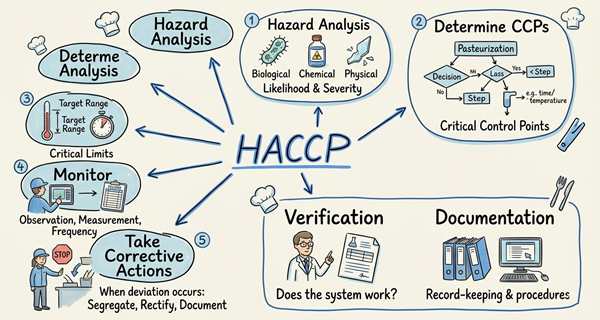
The 7 steps of HACCP are: hazard analysis, identifying critical control points (CCPs), setting critical limits, establishing monitoring procedures, defining corrective actions, verification procedures, and record-keeping.
- Conduct a hazard analysis – Identify potential physical, chemical, or biological hazards in the food production process.
- Determine critical control points (CCPs) – Identify where hazards can be prevented, eliminated, or reduced to safe levels.
- Establish critical limits – Set parameters that must be met at each CCP to ensure safety.
- Establish monitoring procedures – Implement procedures to monitor the critical control points.
- Establish corrective actions – Define corrective actions if CCPs are not met.
- Establish verification procedures – Make sure the system is working as intended.
- Establish record-keeping and documentation – Keep detailed records to prove that safety measures are being followed.
These steps form a cycle that ensures consistent food safety throughout the production process.
What is a HACCP Plan?
A HACCP plan is a detailed document that outlines how a business applies the 7 HACCP steps. It helps businesses identify potential hazards, establish control points, and define safety measures. This plan not only ensures food safety during production but also helps maintain ongoing safety through regular checks and updates. As risks evolve or new processes are introduced, the HACCP plan must be updated to keep food safe and meet safety standards.
How to Implement HACCP?
1.Form a HACCP Team
- Assemble a team of employees with different expertise in your food processing operation (e.g., production, quality control, sanitation).
- This team will be responsible for identifying hazards and creating the HACCP plan.
2.Conduct a Hazard Analysis - Identify potential hazards (biological, chemical, physical) at each stage of food production, from raw materials to final products.
- Look at all processes: receiving, storing, processing, packaging, and distribution.
3. Determine Critical Control Points (CCPs) - Identify steps in the production process where hazards can be prevented, eliminated, or reduced to safe levels.
- For example, checking cooking temperatures or controlling storage conditions.
4. Establish Critical Limits for Each CCP - Define measurable limits for each CCP, such as time, temperature, pH, or salt concentration.
- These limits should be based on scientific data or regulations to ensure safety.
5. Set Up Monitoring Procedures - Establish methods to monitor each CCP, like temperature checks or visual inspections.
- Decide how often to check and who is responsible for monitoring.
6. Establish Corrective Actions - Determine what to do if a CCP is not within the critical limit (e.g., if the temperature is too low, reheat the product).
- Ensure your team knows how to act immediately to prevent unsafe food from reaching consumers.
7. Implement Verification Procedures - Regularly review and verify that your HACCP plan is working. This can include internal audits, testing, or reviewing records.
- Use third-party audits to double-check that your food safety system is effective.
8. Maintain Proper Records - Keep detailed records for each step of the HACCP process, including hazard analysis, monitoring data, corrective actions, and verification activities.
- Records ensure accountability and provide evidence for compliance during audits.
9. Train Your Staff - Provide ongoing training to employees to ensure they understand HACCP principles and their roles in food safety.
- Training should cover proper food handling, equipment use, and sanitation practices.
10. Review and Update the HACCP Plan Regularly - Reassess your HACCP plan whenever changes occur (e.g., new equipment, suppliers, or processes).
- Regularly update the plan to address new risks and improve food safety practices.
What Foods Require HACCP?
- High Contamination Risk Food
Foods that are more likely to cause foodborne illnesses, such as meat, poultry, fish, and dairy. - Ready-to-Eat Foods
Products like salads, sandwiches, and packaged snacks that don’t require further cooking or preparation. - Processed Foods
Foods that undergo processing, like canned goods, frozen meals, or fruit juices. - Food with Potential for Contamination
Foods like eggs, unpasteurized milk, and raw seafood.
While we've listed some common foods that typically require HACCP, it's important to know that whether HACCP is needed depends on the production process and regulations, not just the type of food.
What Businesses Need HACCP?
- Food Manufacturers and Processors
Businesses that produce, process, package, or store perishable food products, such as meat processing plants or dairy processors. - Restaurants and Foodservice Operations
Not all restaurants need HACCP, but those that handle high-risk or ready-to-eat foods (like seafood, raw meats, or unpasteurized products) should follow HACCP principles to ensure food safety. - Food Distributors and Retailers
Companies involved in distributing, storing, or selling food products, including supermarkets, grocery stores, and food retailers. - Food Exporters
Businesses that export food products often need HACCP certification to comply with international food safety standards. - Institutional Food Services
Organizations like schools, hospitals, and prisons that prepare and serve large quantities of food to the public.
Conclusion
In the food industry, following safety standards is key to maintaining consumer trust and reputation. HACCP ensures food safety by preventing hazards before they occur, making it essential for meeting safety standards effectively.